
Hong Kong Mahjong Scoring Table
How many faan each common Hong Kong (Cantonese) mahjong hand is worth and how to add them up, on one page. Mid-game and want to know what a hand scores? Search or filter the table to find it fast. Further down are worked examples and how faan turns into money.
Start recording your games →Free to start, no sign-up. Want to know what each faan pays? See the payout table. New to dealing, calling tiles and going out? Start with how to play Hong Kong mahjong.
Quick faan lookup table
| Hand | Faan | What it is |
|---|---|---|
| Bonus faan (stack with the hand's faan) | ||
| Chicken hand (雞糊) | 0 | A win with no faan; cannot win at a 3-faan minimum table |
| All Chows (平糊) | 1 | Four chows plus a pair |
| Self-drawn (自摸) | 1 | You draw the winning tile yourself |
| Concealed hand (門前清) | 1 | Win without calling any tiles (no pung, chow or exposed kong) |
| Own flower (正花) | 1 | A flower matching your seat wind, 1 faan each |
| No flowers (無花) | 1 | No flower tiles in the whole hand |
| Prevailing / seat wind pung (圈風刻/門風刻) | 1 | A pung of the prevailing wind or your seat wind, counted per set |
| Dragon pung (中發白刻) | 1 | A pung of Red, Green or White dragons, counted per set |
| Robbing the kong (搶槓) | 1 | Win on the tile another player adds to make a kong |
| Last tile draw (海底撈月) | 1 | Self-draw the very last tile of the wall (2 faan at some tables) |
| Win on a kong replacement (槓上自摸) | 1 | Self-draw the win on the replacement tile after a kong (2 faan at some tables) |
| Full flower set (一台花) | 2 | All four seasons (春夏秋冬) or all four flowers (梅蘭菊竹) |
| Common hands | ||
| All Pungs (對對糊) | 3 | Four pungs plus a pair |
| Half Flush (混一色) | 3 | One suit plus honour tiles for the whole hand |
| High-faan hands | ||
| Mixed Terminals (花么九) | 4 | Only 1s, 9s and honour tiles |
| Small Three Dragons (小三元) | 5 | Pungs of two dragons, with the third dragon as the pair |
| Small Four Winds (小四喜) | 6 | Pungs of three winds, with the fourth wind as the pair (8 faan at some tables) |
| Full Flush (清一色) | 7 | Every tile from one suit, no honour tiles |
| Great Three Dragons (大三元) | 8 | Pungs of all three dragons: Red, Green and White |
| All Concealed Pungs (坎坎糊) | 8 | Four concealed pungs, won by self-draw |
| Double kong win (槓上槓自摸) | 8 | Self-draw the win after back-to-back kongs |
| Limit hands (滿糊・爆棚) | ||
| All Honours (字一色) | 10 | Only honour tiles (some tables pay the limit outright) |
| All Terminals (清么九) | 10 | Only 1s and 9s (some tables pay the limit outright) |
| Nine Gates (九蓮寶燈, 九子連環) | 10 | 1112345678999 in one suit plus any tile of that suit (some tables pay the limit outright) |
| Thirteen Orphans (十三么) | 13 (limit) | One each of the 1 and 9 of dots, bamboo and characters, plus East, South, West, North, Red, Green and White, with any one of them as the pair |
| Great Four Winds (大四喜) | 13 (limit) | Pungs of all four winds: East, South, West and North |
| All Kongs (十八羅漢) | 13 (limit) | Four kongs plus a pair |
| Heavenly hand (天糊) | 13 (limit) | The dealer wins on the opening hand |
| Earthly hand (地糊) | 13 (limit) | A non-dealer wins on the dealer's first discard (definitions vary between tables) |
| Flower win (花糊) | 3 | Collect seven flower tiles to win (scoring varies between tables) |
These are the common Hong Kong values. Some hands vary between tables, so agree before you start and go with your table's rules.
Hands explained
Common winning hands
All Chows (平糊)1 faan
Four chows plus a pair, with no pungs anywhere in the hand.
Example: 1-2-3 characters, 4-5-6 dots, 6-7-8 dots, 2-3-4 bamboo, with a pair of 5 bamboo.


All Pungs (對對糊)3 faan
Four pungs plus a pair, with no chows in the hand.
Example: pungs of 2 characters, 5 dots, 7 dots and 9 bamboo, with a pair of 3 bamboo.

Half Flush (混一色)3 faan
The whole hand is one suit plus honour tiles.
Example: only dots and honour tiles.



High-faan hands
Full Flush (清一色)7 faan
Every tile from one suit, with no honour tiles at all.
Example: all characters.


Small Three Dragons (小三元)5 faan
Pungs of two of the dragons (Red, Green, White), with the remaining dragon as the pair.
Plus two other sets. The 5 faan already includes the two dragon pungs (3 plus 2), so you do not add them again.


Great Three Dragons (大三元)8 faan
Pungs of all three dragons: Red, Green and White.
Plus any one set and a pair. The 8 faan already includes the three dragon pungs (5 plus 3), so you do not add them again.
Small Four Winds (小四喜)6 faan
Pungs of three of the winds (East, South, West, North), with the fourth wind as the pair.
Plus one other set.


Special and limit hands
Thirteen Orphans (十三么)13 faan · limit
One each of the 1 and 9 dots, 1 and 9 bamboo, 1 and 9 characters, and East, South, West, North, Red, Green and White, plus one extra of any of them as the pair.
A limit hand: it pays the cap (爆棚) as soon as you win, with no faan to count.


Great Four Winds (大四喜)13 faan · limit
Pungs of all four winds, East, South, West and North (called or concealed both count), plus any pair.
A limit hand: it pays the cap (爆棚) as soon as you win, with no faan to count. Three wind pungs with a wind pair is only Small Four Winds.
All Honours (字一色)10 faan
The whole hand is honour tiles.
Some tables pay the limit outright.
Nine Gates (九蓮寶燈)10 faan
1112345678999 in one suit, plus any tile of the same suit.
Also called 九子連環. Some tables pay the limit outright.
Heavenly and Earthly hands (天糊・地糊)13 faan · limit
Heavenly hand: the dealer wins on the opening hand. Earthly hand: a non-dealer wins on the dealer's first discard.
Definitions of both vary between tables, so agree before you start.
Flower win (花糊)3 faan
Collect seven flower tiles and you win, without building a hand.
Tables score the flower win differently, so agree before you start.


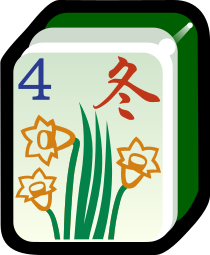


A limit hand (滿糊) pays the cap (爆棚) as soon as you win, with no faan to count item by item. Which hands count as limit hands, and how many faan the limit is, varies between tables.
Tile images: by Cangjie6 (remake), Jerry Crimson Mann (original), User:Dewclouds (vectorisation), own work, CC BY-SA 4.0, Wikimedia Commons.
How to count faan, with examples
Faan measures how big a hand is. When you win, add the hand's faan to any bonus faan to get the total for that hand.
- Stacking: hand faan and bonus faan add up. For example, Half Flush (3 faan) plus All Pungs (3 faan) plus Self-drawn (1 faan) makes 7 faan.
- Minimum to win: the usual Hong Kong rule is a 3-faan minimum, so a Chicken hand below 3 faan cannot win. Some tables play a 1-faan or 2-faan minimum.
- Cap: most tables set a limit. Hitting it is called 爆棚 (the limit, or 滿糊), commonly somewhere from 8 to 13 faan. Limit hands pay the cap as soon as you win.
Worked examples
| Hand | How it counts | Total faan |
|---|---|---|
| Half Flush, four pungs, concealed and self-drawn, one own flower | Half Flush 3 + All Pungs 3 + Concealed hand 1 + Self-drawn 1 + Own flower 1 | 9 faan |
| Four chows plus a pair, won off a discard, no flowers | All Chows 1 + No flowers 1 | 2 faan (cannot win at a 3-faan minimum) |
| Full Flush, four pungs, self-drawn | Full Flush 7 + All Pungs 3 + Self-drawn 1 | 11 faan (pays the limit at a 10-faan cap table) |
| Thirteen Orphans, self-drawn | Limit hand, pays the cap as soon as you win | Limit (爆棚) |
Some hands cannot be counted together. Full Flush already includes Half Flush, so you only count Full Flush. All Chows and All Pungs can never appear in the same hand. Small Three Dragons (5 faan) and Great Three Dragons (8 faan) already include the faan for the dragon pungs themselves. Different tables may use different faan values, so go with whatever you agreed before the game.
What does each faan pay?
What a faan is worth depends on your stake (二五雞, 五一 or 一二蚊, which pay $8, $16 or $32 at 3 faan) and your doubling rule. A separate page has it all in one table: Hong Kong mahjong payout table →
 Checked the faan? Record the hand
Looking up faan is only one part of the game. To keep track of who won and lost each session, build up results over time, or see a leaderboard among friends, use Mahjong Logbook: open the mahjong score tracker at the table and log each hand, and faan is turned into money for you. Long-term results, trends and head-to-head records build up on their own; see mahjong records and results (in Chinese).
Start recording for free →No sign-up. Open a room and you are ready.
FAQ
How many faan do you need to win?
The most common Hong Kong rule is a 3-faan minimum: a Chicken hand (雞糊) below 3 faan cannot win. Some tables play a 1-faan or 2-faan minimum instead; just agree on it before you start.
How does faan turn into money?
The payout multiplies as the faan goes up. The actual amount depends on the stake your table plays (for example 二五雞, 五一 or 一二蚊) and whether hands from 4 faan up use full doubling (辣辣上) or half-doubling (半辣上). For what each faan pays, see the Hong Kong mahjong payout table.
Do faan values differ between tables?
Yes. This page lists the common Hong Kong values. Some hands vary between tables, for example Last tile draw (海底撈月), Flower win (花糊) and All Honours (字一色), so agree before you start and go with your table's rules.
How do you count faan in mahjong?
First work out the hand type (All Chows, All Pungs, Half Flush, Full Flush and so on), then add the bonus faan (Self-drawn, Concealed hand, own flower, prevailing or seat wind pung, dragon pung and so on). Add it all up and that is the total faan. For example, Half Flush plus All Pungs plus Self-drawn is 7 faan. Then check the payout table against your stake and doubling rule to see what it pays.
How many faan is Great Four Winds?
Great Four Winds (大四喜) is a limit hand. The common Hong Kong scoring counts it as 13 faan, so it pays the cap (爆棚) as soon as you win. It needs four wind pungs (East, South, West, North) plus any pair; three wind pungs with a wind pair is only Small Four Winds (小四喜), worth 6 faan (8 faan at some tables). At 二五雞 with half-doubling and a 10-faan cap, a Great Four Winds won off a discard pays $128.
How many faan is Full Flush?
Full Flush (清一色) is 7 faan: every tile is from one suit, with no honour tiles at all. Full Flush already includes Half Flush, so you do not add Half Flush's 3 faan on top. All Pungs adds 3 more and Self-drawn adds 1, so it can stack to 11 faan.
How many faan are Half Flush and All Pungs?
Half Flush (混一色) and All Pungs (對對糊) are 3 faan each, and they stack: a Half Flush All Pungs hand is 6 faan, before bonus faan such as Self-drawn or Concealed hand.
How many faan are Great Three Dragons and Small Three Dragons?
Great Three Dragons (大三元: pungs of Red, Green and White dragons) is 8 faan. Small Three Dragons (小三元: two dragon pungs with the third dragon as the pair) is 5 faan. Both already include the faan for the dragon pungs themselves, so you do not add them again set by set.
How many faan is Thirteen Orphans?
Thirteen Orphans (十三么) is a limit hand. The common Hong Kong scoring counts it as 13 faan, so it pays the cap (爆棚) as soon as you win, with no bonus faan to add.
For how faan becomes money, see Cantonese mahjong scoring (in Chinese). For the full flow from dealing to winning, see how to play Hong Kong mahjong, and look up unfamiliar terms in the Cantonese mahjong glossary. Does your table play Taiwanese-style? The HK-Taiwanese faan table (in Chinese) has its own page.